
Before the first trimester, there's trimester zero.
The egg and sperm that become your baby are developing right now. What you both eat and do in the months before conception shapes those cells. I help couples start 6 to 12 months ahead, with time to test, correct and prepare.
Book my free 30-minute callDenise Klein, MS, CNS
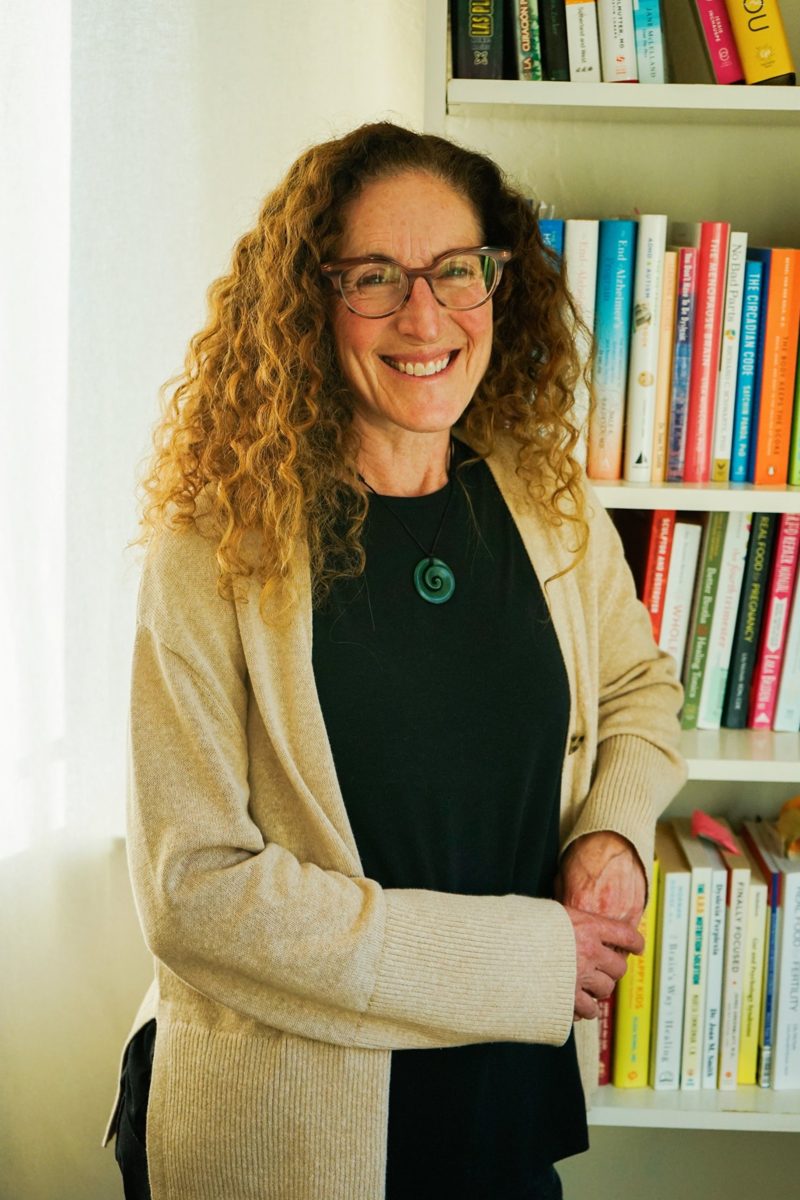
Pregnancy prep starts earlier than most people think.
Most of us take a year to plan a wedding, or train for months to run a marathon. But most couples don't prepare for pregnancy at all. Let me show you how.
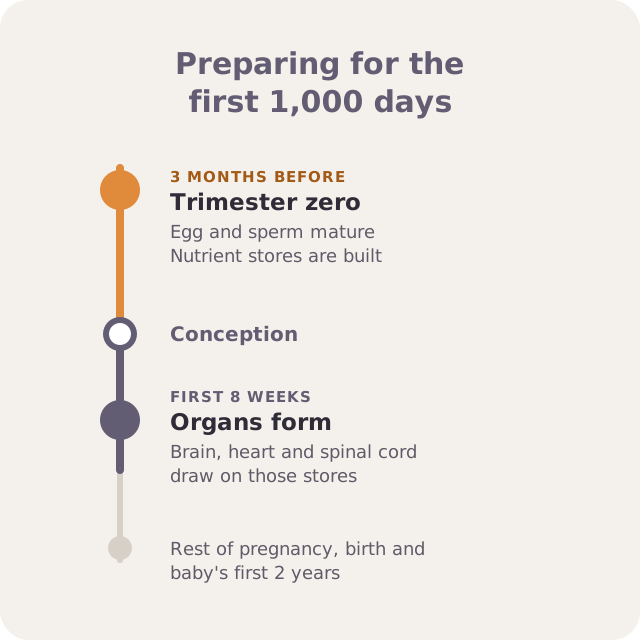
Stocking the pantry for the first 1,000 days
The first 1,000 days, from conception to your child's second birthday, are the most important window for your baby's brain and lifelong health. Research by Dr. Michael Georgieff, a neonatologist and professor of pediatrics at the University of Minnesota, shows that nutrients like iron, DHA, choline and folate drive brain development in this window (Schwarzenberg & Georgieff, 2018).
Some of the most demanding work happens in the first 8 weeks of pregnancy, when your baby's brain, heart and organs form, often before you know you're pregnant. And because egg and sperm take about three months to mature, what you both eat and do now shapes the very cells that become your baby.
That's trimester zero: stocking the pantry, so your baby has what they need from day one.
Why trimester zero matters
A healthier pregnancy
Health before conception is linked to better outcomes for mom and baby, including lower risks of gestational diabetes, high blood pressure and preterm birth (Stephenson et al., 2018).
Supporting fertility, for both of you
Three months of focused nutrition and lifestyle changes for both partners can support ovulation, egg and sperm quality, implantation and placental health.
Your baby's lifelong health
Research links parents' nutrition and health around conception to their child's long-term heart, metabolic, immune and brain health (Fleming et al., 2018).
A healthy microbiome to pass on
At birth, your baby is seeded with microbes from your body, which help shape their own gut microbiome (Ferretti et al., 2018). I'll teach you how to use food to build a diverse, healthy one to pass on.
Pregnancy asks a lot of your body
- Your blood volume expands by up to 50%, and every new red blood cell needs iron.
- Pregnancy uses about 1,000 mg of iron, with the highest demand in the third trimester (Bothwell, 2000).
- In the third trimester, your baby takes in about 67 mg of omega-3 fats a day, mainly DHA, for their growing brain and eyes (Gázquez & Larqué, 2021).
- Iron and omega-3s can take months to rebuild, so testing early gives you time to correct what's low before pregnancy, not during it.
Start pregnancy with full stores, and they last the whole journey, through the third trimester and into birth and breastfeeding, without draining your own reserves.
What we look at together
- Nutrient stores like iron, DHA, choline and folate, and how long each takes to rebuild
- The prenatal vitamin that's the best fit for you
- Digestion and absorption, especially with celiac disease, IBS, autoimmune conditions or microbiome issues
- Blood sugar balance to steady energy and support hormones
- Your cycle and ovulation, including support for IVF or IUI
- Everyday environmental exposures and simple swaps
The couples I work with tell me the same thing: "I wish I had known this sooner." Starting 6 to 12 months out means you get to do this calmly, with time on your side.
Book my free 30-minute callYour free Preconception Readiness Call
In 30 minutes on Zoom, you'll walk away with:
- Your prep timelineWhere to start based on when you want to begin trying.
- A prenatal vitamin recommendationWhich prenatal vitamins might be a good fit for you.
- A health insurance checkWe'll talk through your coverage for preconception and pregnancy care.
- The benefits of a preconception OB-GYN visitWhat it is, and how it can help you start pregnancy prepared.
Your partner is welcome to join. If working together makes sense, I'll explain how. If not, you'll still leave with clear next steps.
This is for you if…
- You want to start trying in the next 6 to 18 months, maybe right after the wedding.
- You want to know which changes make the biggest difference for your baby, whether you're already eating well or just getting started.
- You want the science explained, not a list of rules.
- You have celiac disease, IBS, an autoimmune condition or gut issues that can affect how well you absorb nutrients.
- You're preparing for IVF or IUI and want your nutrition working for you.
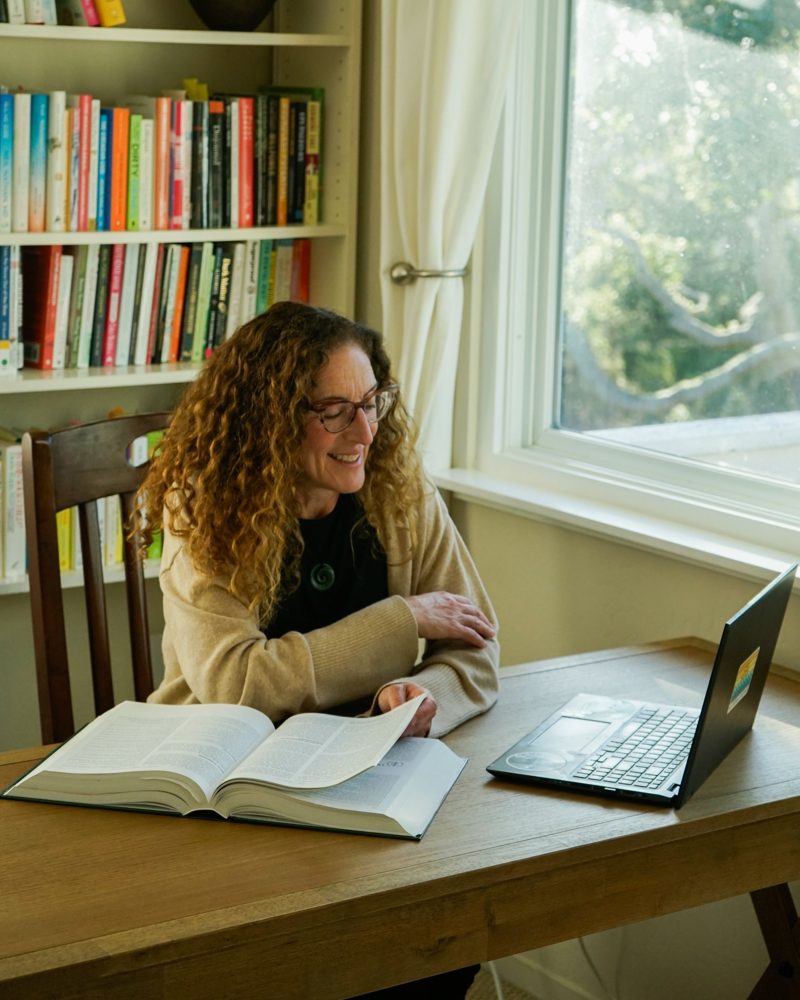
Hi, I'm Denise.
For almost 20 years, I helped assess and tutor children and adults with ADHD and learning differences. I kept asking: what if we could support the brain before it's even built? That question led me back to school for a master's in nutrition and functional medicine, and to the research on the first 1,000 days.
Today I focus on one thing: the nutrient stores that build your baby's brain, starting before conception. I explain what's happening in your body, step by step, so every change makes sense. I work alongside your OB or midwife, not instead of them.
Denise Klein, MS, CNS · Certified Nutrition Specialist
Virtual, based in California · Sessions in English or Spanish
What clients say
I was lucky enough to find her and start working with her two months before I became pregnant, which gave me such a valuable head start going into pregnancy… She taught me about things I would never have thought to ask about, from placenta positioning to the importance of iron during pregnancy and breastfeeding.
— Bella G.
I worked with Denise on preconception nutrition while going through fertility treatments… Having a positive area to focus my attention and something I could have control over was incredibly helpful during an otherwise difficult time. My vitamin D and ferritin levels both improved while working with Denise.
— Stephanie C.
She has guided me through my preconception journey with the utmost kindness and support… Together we made a step by step plan that has given me so much insight to what my body needs.
— Carley W.
She offered recommendations on key bloodwork for early pregnancy, identifying certain deficiencies before any doctor could!
— Eileen B.
Three simple steps
Book your free call
Pick a time that works. It's 30 minutes on Zoom.
Get your starting plan
We'll map your prep timeline, look at which prenatal vitamins might be a good fit, talk through your health insurance, and cover the benefits of a preconception OB-GYN visit.
Prepare with support, if you want it
My Preconception Preparation Program gives you one-on-one sessions over 3 to 6 months, personalized to your labs, cycle and goals. If you get pregnant along the way, your remaining sessions carry into pregnancy.
Questions
Is the call really free?
Yes. It's 30 minutes, and you'll leave with next steps whether or not we work together.
We want to start trying sooner than 6 months. Is it too late?
Not at all. We'll focus on the highest-impact changes for the time you have.
I'm already pregnant. Is it too late to work with you?
No. I have programs for preconception, pregnancy and postpartum, so I can support you wherever you are. See my pregnancy program, or book a free call and we'll find the right fit.
Should my partner join?
Yes, if they can. Sperm take about 74 days to develop, so their prep counts too.
Is it virtual?
Yes, all sessions are on Zoom, in English or Spanish.
References
Bothwell, T. H. (2000). Iron requirements in pregnancy and strategies to meet them. The American Journal of Clinical Nutrition, 72(1 Suppl), 257S–264S. https://doi.org/10.1093/ajcn/72.1.257S
Ferretti, P., Pasolli, E., Tett, A., Asnicar, F., Gorfer, V., Fedi, S., Armanini, F., Truong, D. T., Manara, S., Zolfo, M., Beghini, F., Bertorelli, R., De Sanctis, V., Bariletti, I., Canto, R., Clementi, R., Cologna, M., Crifò, T., Cusumano, G., … Segata, N. (2018). Mother-to-infant microbial transmission from different body sites shapes the developing infant gut microbiome. Cell Host & Microbe, 24(1), 133–145.e5. https://doi.org/10.1016/j.chom.2018.06.005
Fleming, T. P., Watkins, A. J., Velazquez, M. A., Mathers, J. C., Prentice, A. M., Stephenson, J., Barker, M., Saffery, R., Yajnik, C. S., Eckert, J. J., Hanson, M. A., Forrester, T., Gluckman, P. D., & Godfrey, K. M. (2018). Origins of lifetime health around the time of conception: Causes and consequences. The Lancet, 391(10132), 1842–1852. https://doi.org/10.1016/S0140-6736(18)30312-X
Gázquez, A., & Larqué, E. (2021). Towards an optimized fetal DHA accretion: Differences on maternal DHA supplementation using phospholipids vs. triglycerides during pregnancy in different models. Nutrients, 13(2), 511. https://doi.org/10.3390/nu13020511
Schwarzenberg, S. J., & Georgieff, M. K. (2018). Advocacy for improving nutrition in the first 1000 days to support childhood development and adult health. Pediatrics, 141(2), e20173716. https://doi.org/10.1542/peds.2017-3716
Stephenson, J., Heslehurst, N., Hall, J., Schoenaker, D. A. J. M., Hutchinson, J., Cade, J. E., Poston, L., Barrett, G., Crozier, S. R., Barker, M., Kumaran, K., Yajnik, C. S., Baird, J., & Mishra, G. D. (2018). Before the beginning: Nutrition and lifestyle in the preconception period and its importance for future health. The Lancet, 391(10132), 1830–1841. https://doi.org/10.1016/S0140-6736(18)30311-8
Give your baby's brain a head start.
The best time to prepare is before you start trying. Let's map your timeline.
Book my free 30-minute call